

Most students meet AI through prompts. Type a question, get a paragraph back, move on.
That framing is useful for five minutes and then it gets in the way.
The more interesting lesson is what happens when you stop treating a model like a single all-knowing assistant and start treating it like one noisy component in a bigger system. Give several model instances the same problem. Ask each one for an answer. Make them criticise each other. Force another round. Then have a judge combine the best points.
Suddenly the discussion stops being about prompt wording and starts being about architecture.
That is why multi-agent debate matters. Not because six chat windows arguing with each other are cute, and not because debate turns an LLM into a reliable thinker. It matters because the pattern exposes what these systems are actually good at, where they fail, and what good computer science students should notice before they get hypnotised by demo videos.
My take is blunt: prompt engineering is the least interesting part of this story. System design is the lesson.
What multi-agent debate actually is
The 2023 paper "Improving Factuality and Reasoning in Language Models through Multiagent Debate" describes a simple setup: multiple language model instances propose answers, debate them over several rounds, and then converge on a final answer. The authors report improvements on mathematical and strategic reasoning tasks, along with reductions in fallacious and hallucinatory responses compared with single-agent baselines.
The idea is not mystical. You are building a feedback loop.
A basic debate pipeline usually looks like this:
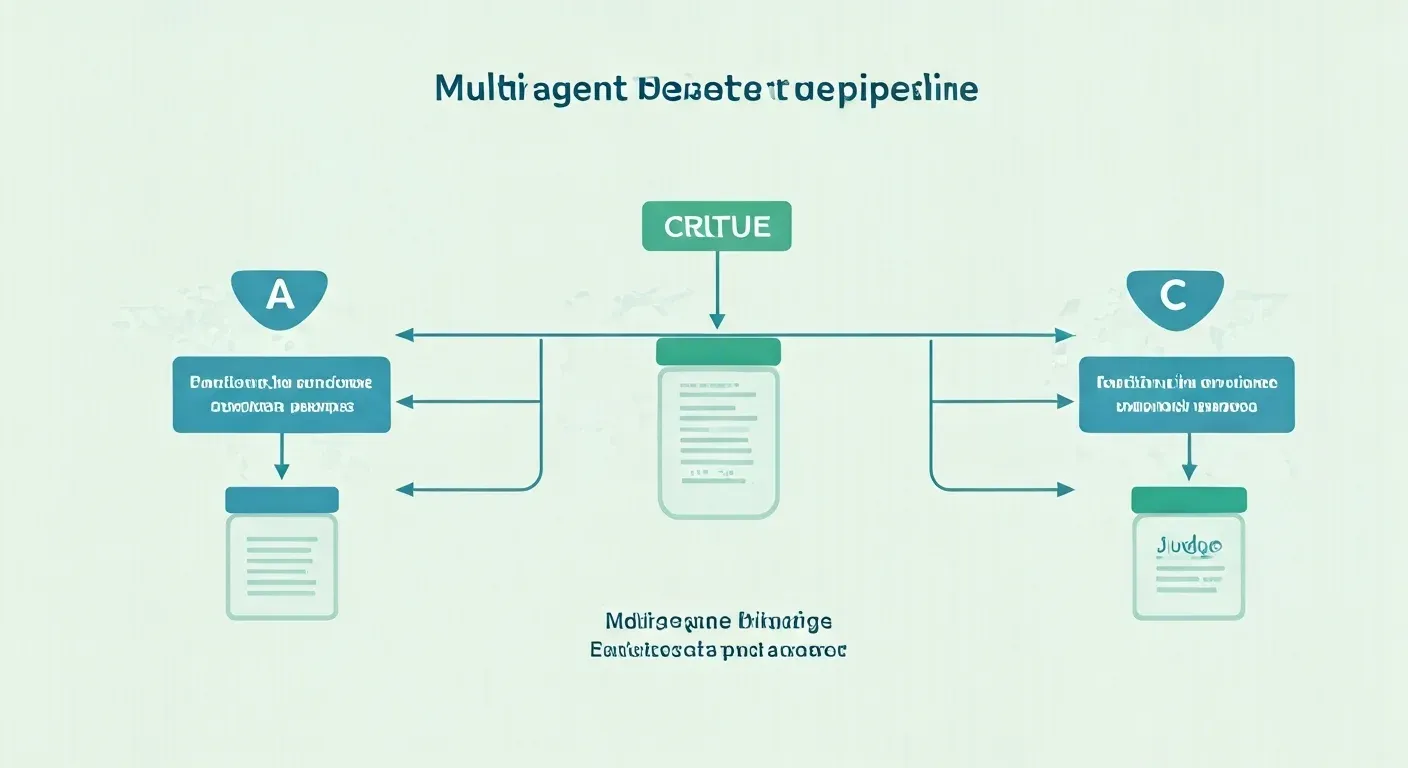
- Agent A, B, and C each answer the same prompt independently.
- Each agent reads the others' answers and points out weak logic, missing steps, or contradictions.
- Each agent revises its own answer after seeing criticism.
- A final judge, or one more synthesis pass, picks the strongest parts.
That workflow borrows from something humans already do in programming: code review. One developer writes the first pass. Another person spots the broken assumption. Someone else notices the edge case. The final version is better, not because one brain became smarter, but because the process exposed mistakes before they shipped.
If you have read my piece on searching old AI conversations, the same pattern shows up there too. The value is often in the review loop, not the first output.
What debate reveals about LLM architecture
This is the part students should care about.
A large language model is still an autoregressive system that predicts the next token from context. The GPT-3 paper describes it as an autoregressive language model, and the 2022 paper "Chain-of-Thought Prompting Elicits Reasoning in Large Language Models" showed that giving models room to produce intermediate reasoning steps can improve results on arithmetic, commonsense, and symbolic tasks. Multi-agent debate pushes that same idea one step further: instead of one long reasoning trace, you create several traces and let them attack each other.
That tells you something important.
A lot of what people call "reasoning" in practice is not a hidden mode that switches on inside the model. It is often the result of structure wrapped around the model: extra steps, extra context, criticism, retries, and selection. In other words, the intelligence you see is partly in the orchestration.
I think students need to hear that early, because the internet keeps selling the opposite story. One flashy demo appears, people act as if the model has crossed some mysterious line, and the system design vanishes from the conversation.
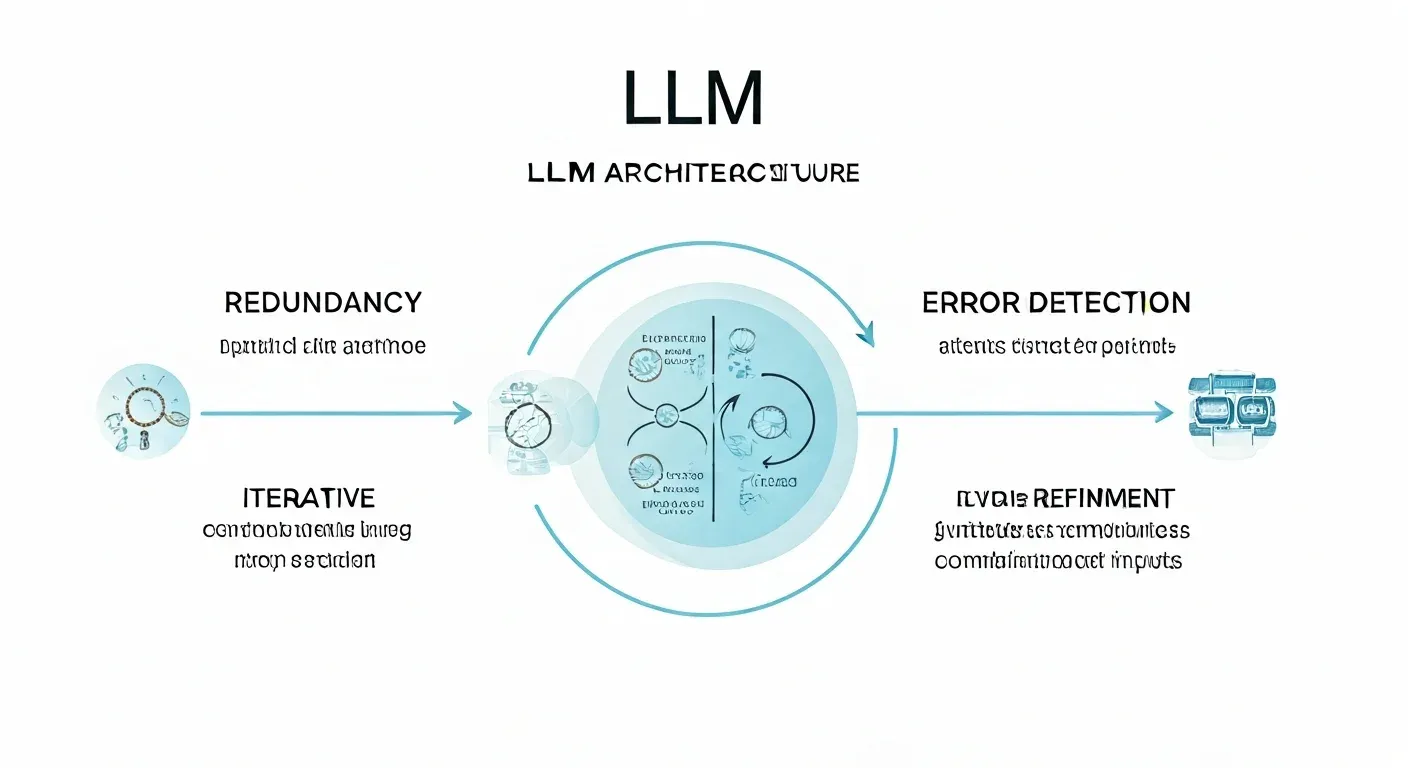
But look at what debate is doing under the hood:
- redundancy, because several agents attempt the task
- error detection, because agents inspect each other's reasoning
- iterative refinement, because answers are revised instead of accepted once
- aggregation, because a judge or synthesis pass chooses among alternatives
Those are architecture decisions. They are not prompt tricks.
That is also why multi-agent systems look a lot like classic CS ideas wearing new clothes. Distributed systems use redundancy because one node can fail. Compilers use multiple passes because one pass is not always enough. Software teams use tests and review because the first version is rarely the final one. Debate is the same instinct applied to a probabilistic text engine.
The useful lesson is not "AI thinks better in groups"
Be careful with the headline version of this idea.
It is tempting to say that a group of agents "thinks" better than one agent. I would phrase it more carefully. A structured group process can produce better outputs than a single pass because it creates more chances to catch obvious mistakes.
That difference matters.
If three weak answers all share the same bad assumption, debate does not magically rescue you. It can even make the wrong answer sound more convincing, because now it arrives with consensus theatre attached. Agreement is not proof. A polished synthesis is not proof either.
That is one reason I still prefer grounded workflows over pure discussion workflows. The 2022 paper "ReAct: Synergizing Reasoning and Acting in Language Models" is useful here because it combines reasoning traces with actions that fetch external information. For factual tasks, a debating panel with no access to evidence is still trapped inside its own guesses.
So yes, debate can help. No, it does not turn a language model into a truth machine.
Why CS students should care
If I were teaching this to a class, I would not present multi-agent debate as an AI party trick. I would use it to teach systems thinking.
Students usually start with the surface layer: the prompt. That is understandable. It is the part they can see.
But the deeper question is this: what kind of system are you building around an unreliable component?
That question is pure computer science.
1. It teaches decomposition
A decent multi-agent workflow splits one job into smaller responsibilities: proposer, critic, judge, verifier. That is exactly how good software systems are designed. Different parts do different jobs. Nobody asks the same component to generate, verify, rank, and explain everything perfectly in one pass.
2. It teaches evaluation
Students often stop at "the AI answered." Debate forces the next question: answered according to what standard?
Was the logic complete? Did it use evidence? Did two agents agree for the same reason, or did one just copy the other? What would count as a failure case?
Those are evaluation questions, and they matter more than the prompt itself. I made a similar point in my guide on how to set up a test pipeline that actually catches bugs, because good systems need clear checks, not vibes.
3. It teaches observability
One reason single-shot AI tools are slippery is that you only see the final sentence. Debate systems expose more of the path. You can inspect the initial answers, the objections, the revisions, and the final merge. That makes the system easier to debug.
It is the same reason tracebacks matter in programming. If you only saw "program failed," you would learn very little. If you can inspect the chain of events, you can actually reason about the bug. That is why I keep pushing students toward explicit debugging habits instead of one-shot guesswork.
4. It teaches trade-offs
Debate sounds clever until you pay for it.
Three rounds with four agents is already twelve model calls before the judge speaks. Latency goes up. Cost goes up. Failure modes multiply. Prompt leakage between agents becomes a design issue. Logging becomes a design issue. Rate limits become a design issue.
That is good news for a CS classroom, because now the conversation is finally real. Students are not just asking, "Can AI do it?" They are asking, "What did this architecture cost, and was the gain worth it?"
That is a much better question.
Three debate frameworks students can try
You do not need a research lab to experiment with this. You just need to keep the tasks small and the scoring clear.
The two-agent critic loop
This is the simplest version.
- Agent 1 writes an answer.
- Agent 2 critiques it line by line.
- Agent 1 revises once.
Use it for short explanations, code comments, or a paragraph answering a theory question. Students learn quickly that the second pass is often less about brilliance and more about catching omissions.
The three-agent committee
Give the same question to three isolated agents. Do not let them see each other at first. Then ask a judge to compare them against a rubric.
This works well for structured tasks: design choices, algorithm explanations, short essays, and worked examples. The point is not to vote blindly. The point is to inspect disagreement. When two answers agree and one dissents, students should ask why.
The evidence-first debate
This is the one I would push hardest.
Before any agent can argue, each one has to quote or retrieve evidence from an approved source set: lecture notes, a paper extract, a dataset, or a fixed documentation page. Only then can the critique round begin.
That rule stops the exercise from turning into a confidence contest. It also teaches a habit students badly need in the AI era: separate fluent output from justified output.
If students want to run these experiments locally, they do not need an expensive machine. Smaller local setups are enough for classroom-scale tests, especially if the tasks are short and the models are modest. I covered that trade-off in my guide on
 Techie Mike
For experimentation, architecture matters more than brute force.
Where the hype gets ahead of reality
This is where I part company with the more breathless AI commentary.
When people show a multi-agent demo, they often imply that the magic comes from "more agents." I do not think that is the right takeaway. Past a certain point, adding more agents can just add more noise, more cost, and more nicely formatted nonsense.
The better question is whether each added step has a job.
Does one agent bring independent evidence? Does one agent act as a strict verifier? Does one round of critique catch a failure mode you have actually observed?
If the answer is no, you are probably building theater.
I see the same issue in some local AI tooling conversations too. People pile on frameworks because the stack looks impressive, not because each layer solves a real problem. That is why I keep coming back to practical architecture choices in posts like
 Techie Mike
More moving parts only help when each part earns its place.
What I would want students to remember
If this topic lands anywhere useful in a CS classroom, it should land here.
A language model is not the whole system.
The prompt is not the whole system.
The benchmark screenshot is definitely not the whole system.
What matters is how you handle uncertainty, error checking, evidence, revision, and cost around a component that is fluent but unreliable. Multi-agent debate is worth studying because it makes those design choices visible.
That is the lesson I would argue for: AI architecture is a systems problem first, and a wording problem second.
A simple classroom version is to give three agents the same algorithm explanation, ask each one to identify the weakest assumption in the others' answers, then have students compare the final synthesis against a rubric. That keeps the lesson concrete. Students can see whether the extra critique round exposed a real weakness or just produced more polished noise.
Students who understand that will build better tools, ask better questions, and fall for fewer demos.
That seems more useful than teaching them how to write one more clever prompt.